
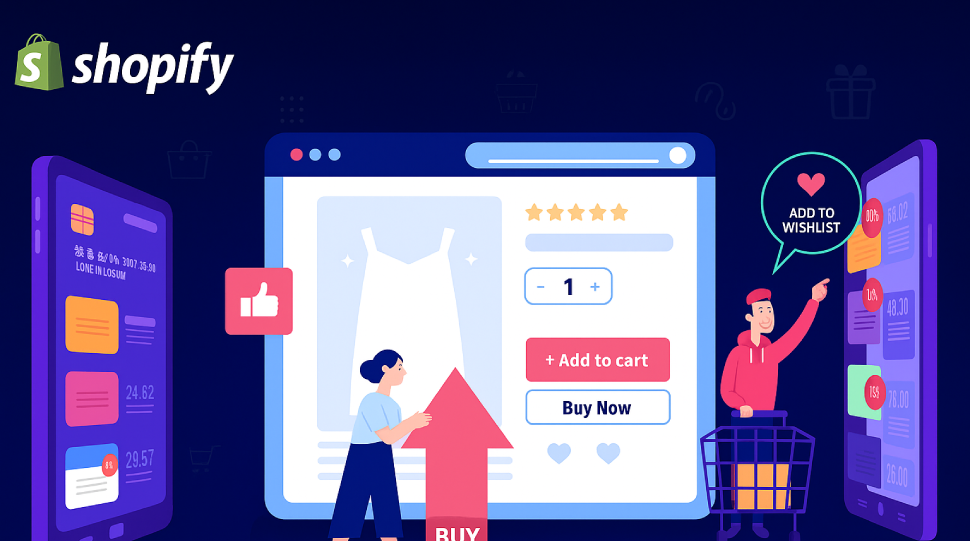
How to Improve Shopify Store Conversions with Data-Driven CRO Techniques
In eCommerce, traffic alone doesn’t guarantee sales. Many Shopify stores struggle with high visitor
numbers but low conversions. The missing piece? Conversion Rate Optimization (CRO).
By applying data-driven CRO strategies, you can turn browsers into buyers, maximize revenue,
and create a seamless shopping experience that builds long-term loyalty.
This guide explores proven CRO techniques tailored for Shopify—backed by analytics, user
behavior insights, and testing.
What is Conversion Rate Optimization (CRO) for Shopify?
Conversion Rate Optimization (CRO) is the process of systematically improving your Shopify
store’s design, content, and user journey to increase the percentage of visitors who take desired
actions (e.g., making a purchase, adding to cart, subscribing).
Unlike guesswork, data-driven CRO uses analytics, heatmaps, and A/B testing to identify what
works best for your customers.
Why CRO is Critical for Shopify Success
• Higher ROI: Get more sales from existing traffic without extra ad spend.
• Improved UX: Better navigation and layout lead to happier customers.
• Reduced Cart Abandonment: Streamlined checkout keeps buyers from dropping off.
• Sustainable Growth: CRO compounds over time as you continuously refine.
Data-Driven CRO Techniques for Shopify
Here are the top strategies to improve conversions in your Shopify store:
1. Analyze User Behavior with Heatmaps & Session Recordings
• Use tools like Hotjar, Crazy Egg, or Lucky Orange to track where users click, scroll, or
drop off.
• Identify friction points (e.g., users leaving before checkout).
• Test changes like repositioning CTAs or simplifying product pages.
3. Optimize Your Product Pages with Data Insights
• Use Shopify Analytics to see which products have high impressions but low sales.
• Improve product images (360° views, lifestyle shots).
• Add trust signals: reviews, ratings, secure checkout badges.
• Include benefit-driven descriptions instead of just features.
5. Speed Up Your Shopify Store
• A 1-second delay in load time can reduce conversions by up to 20%.
• Compress images, remove unused apps, enable lazy loading.
• Test speed with Google PageSpeed Insights and Shopify’s built-in reports.
7. Use Exit-Intent Popups & Cart Recovery Emails
• Trigger popups with discounts or free shipping when users try to leave.
• Set up automated abandoned cart emails with reminders and incentives.
• Example: “Still thinking it over? Get 10% off your cart today!”
9. Build Trust with Transparent Policies
• Display clear shipping, return, and refund policies.
• Offer money-back guarantees.
• Highlight secure payment icons at checkout.
2. Run A/B Tests on Key Pages
• Test variations of product titles, descriptions, images, and CTAs.
• Start with high-traffic, high-revenue pages (homepage, top-selling products, checkout).
• Tools: Google Optimize, Optimizely, VWO.
• Example: Test “Buy Now” vs. “Add to Cart” button text.
4. Personalize User Experience with AI
• Recommend products based on browsing and purchase history.
• Use Shopify apps like LimeSpot, Rebuy, or Nosto for AI-powered personalization.
• Example: “Customers who bought this also loved…”
6. Streamline Checkout Flow
• Enable Shopify’s one-page checkout.
• Offer multiple payment methods (Shop Pay, PayPal, Apple Pay, Google Pay).
• Autofill fields and show progress indicators to reduce drop-offs.
8. Leverage Social Proof & UGC (User-Generated Content)
• Display real customer reviews, star ratings, and testimonials.
• Add Instagram feeds or customer photos wearing/using your product.
• Video reviews increase conversions significantly.
10. Continuously Measure & Improve
• Track key metrics: conversion rate, average order value (AOV), bounce rate.
• Use Google Analytics 4 (GA4) + Shopify reports for insights.
• Implement a CRO cycle: Measure → Test → Learn → Repeat.
“Data-driven CRO is the fastest way to turn more visitors into paying customers. Head back to explore our complete Conversion Optimization Services for Shopify success.”
Based on Real Data – No assumptions, only proven insights.
✅ Customer-Centric – Focuses on reducing friction and building trust.
✅ Revenue-Boosting – Increases sales without increasing ad costs.
Next Steps: Let Born Techies Optimize Your Shopify CRO
At Born Techies, we help Shopify stores maximize conversions through tailored CRO
strategies. Our process includes:
• ✅ Data-Driven CRO Audit
• ✅ Heatmap & Analytics Review
• ✅ A/B Testing Implementation
• ✅ Checkout Flow Optimization
• ✅ Ongoing CRO Growth Strategy
🚀 Ready to turn more clicks into customers? Contact Born Techies today and let’s optimize your
store for higher conversions.
People Also Search For
• Shopify CRO strategies 2025
• Best CRO tools for Shopify
• How to reduce cart abandonment Shopify
• Shopify A/B testing guide
• CRO vs SEO for Shopify
“Maximize sales without spending more on ads by applying powerful CRO strategies. Learn how our experts help Shopify stores achieve higher ROI with proven techniques.”

Frequently Asked Questions ✅
1. What is conversion rate optimization (CRO) and why is it important for Shopify stores?
Conversion Rate Optimization (CRO) is the systematic process of increasing the percentage of website visitors who complete desired actions, such as making a purchase, signing up for a newsletter, or adding products to a cart. For Shopify stores, CRO is critical because attracting traffic is only half the battle—turning that traffic into paying customers is what drives revenue. Data-driven CRO uses analytics, A/B testing, and customer behavior insights to identify friction points and optimize the user journey, resulting in higher sales, reduced cart abandonment, and improved overall store performance.
2. How can Shopify store owners use data-driven techniques to improve conversions?
Shopify store owners can leverage data-driven CRO techniques by analyzing customer behavior through tools like Google Analytics, Hotjar, and Shopify’s own analytics dashboard. Key strategies include tracking click paths, identifying drop-off points in the checkout process, monitoring product page engagement, and measuring bounce rates. By using this data, store owners can make informed decisions, such as optimizing product descriptions, redesigning CTAs, or simplifying navigation, which directly improve conversion rates.
3. What are the most effective A/B testing strategies for Shopify CRO?
A/B testing involves comparing two versions of a webpage or element to determine which performs better in driving conversions. On Shopify, effective A/B testing strategies include testing different product page layouts, call-to-action buttons, checkout flows, pricing displays, and promotional banners. For instance, testing a “Buy Now” button versus an “Add to Cart” button can reveal which encourages more purchases. Continuous testing and iteration help refine the store experience and maximize revenue growth over time.
4. How can Shopify store owners reduce cart abandonment using CRO techniques?
Reducing cart abandonment is crucial for improving conversion rates. Data-driven CRO techniques for Shopify include analyzing the checkout funnel to identify friction points, offering limited-time discounts or free shipping, implementing exit-intent popups, and simplifying the checkout process. Additionally, sending automated abandoned cart emails based on user behavior can recover lost sales. By combining analytics with targeted optimizations, Shopify stores can significantly increase completed purchases and overall conversion rates.
5. How can improving product pages boost Shopify store conversions?
Product pages are often the most critical point in the buying journey. Optimizing them for CRO includes using high-quality images, detailed product descriptions, customer reviews, trust badges, and clear pricing information. Data-driven insights, like heatmaps and click tracking, can reveal which elements attract attention and which cause drop-offs. By enhancing product pages with persuasive content and a seamless user experience, Shopify stores can increase the likelihood that visitors add items to their carts and complete purchases.
6. How does website speed and mobile optimization impact Shopify conversion rates?
Website speed and mobile usability directly affect conversion rates on Shopify stores. Studies show that even a 1-second delay in page load can reduce conversions by up to 7%. Data-driven CRO techniques include optimizing images, using fast hosting, minimizing code, and ensuring responsive design for mobile devices. By providing a fast, smooth browsing experience across all devices, Shopify stores reduce bounce rates, keep customers engaged, and increase the likelihood of completed purchases.
7. Can personalized experiences increase Shopify store conversions?
Yes, personalized shopping experiences significantly boost conversions. Data-driven CRO leverages customer behavior, purchase history, and demographics to deliver tailored product recommendations, dynamic content, and targeted promotions. For example, showing recommended products based on previous purchases or browsing behavior encourages upsells and repeat purchases. Personalization not only improves engagement but also builds trust and loyalty, resulting in higher Shopify conversion rates and lifetime customer value.
